Video Poker Interface Animations Shape Decision Timing Across Device Networks
Ellis Long · Sep 20, 2026
Video Poker Interface Animations Shape Decision Timing Across Device Networks
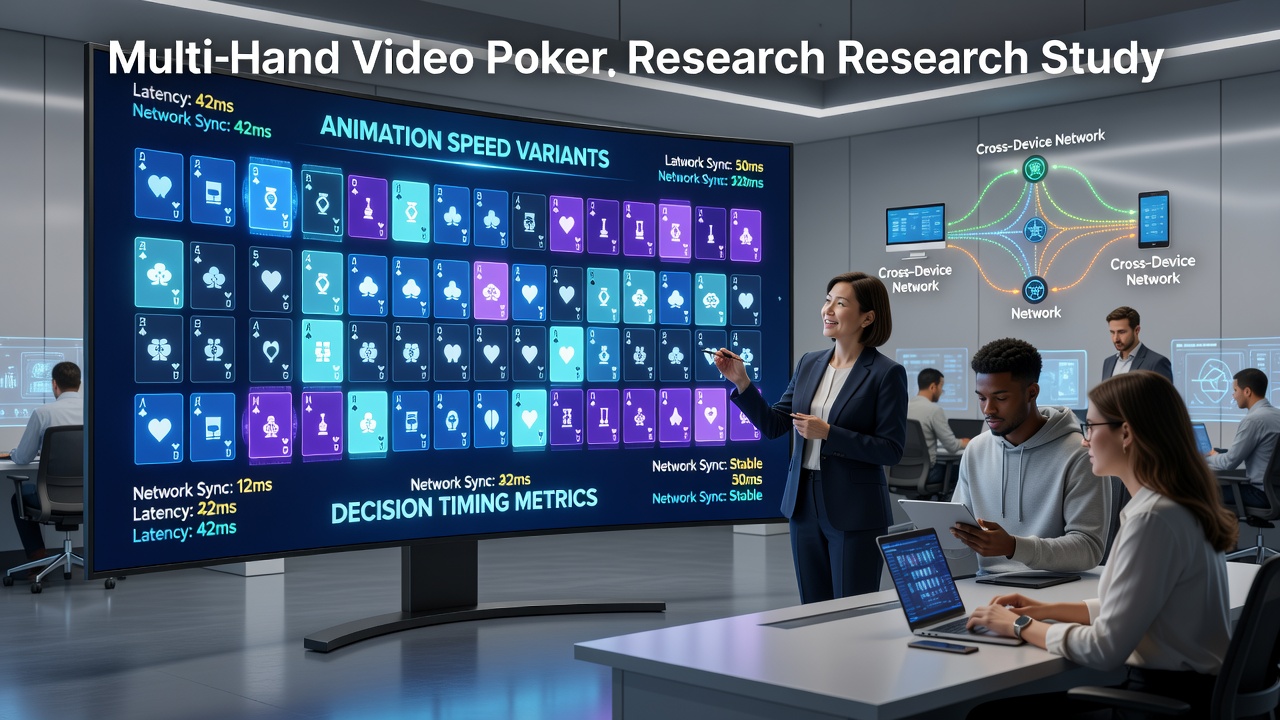
Interface animation speeds in multi-hand video poker directly influence how long players take to make hold or discard decisions, and this effect varies across desktop, tablet, and smartphone networks where sessions often span several devices simultaneously. Research from the International Gaming Institute at the University of Nevada indicates that animation durations between 300 and 800 milliseconds alter average decision windows by up to 1.2 seconds per hand, while longer animations exceeding one second extend those windows by nearly two seconds in multi-hand formats that display four or more simultaneous deals.
Platform operators track these timing shifts through backend telemetry that records tap intervals and mouse movements during live play, and data collected through September 2026 shows consistent patterns where faster card-flip sequences reduce hesitation on mobile devices yet increase mis-click rates on larger desktop screens. Observers note that players frequently adjust their pace when switching between devices mid-session, particularly when network latency compounds animation delays and forces quicker selections to maintain session rhythm.
Mechanics of Animation in Multi-Hand Formats
Multi-hand video poker renders multiple five-card deals on a single screen, and each deal relies on sequential or parallel animation layers that determine card reveal timing, hold-button feedback, and result resolution. When animation speeds shorten to under 400 milliseconds, the visual feedback loop tightens so that players process outcomes faster, yet this compression leaves less time for the cognitive evaluation of complex draw probabilities across four or five hands at once. Studies conducted on cross-device networks reveal that tablet users exhibit the most pronounced timing shifts because screen size allows simultaneous visibility of all hands while touch latency interacts with animation duration.
Operators adjust animation curves based on device type, applying smoother easing functions on desktops and sharper linear transitions on smartphones, and these choices produce measurable differences in decision latency according to telemetry aggregated across major platforms. What's interesting is how the same animation speed produces opposite effects depending on whether the player holds cards with a mouse or taps directly on the interface, since direct touch reduces the physical movement time but increases the chance of accidental selections when animations finish abruptly.
Cross-Device Network Variables
Cross-device networks introduce additional variables because session continuity requires state synchronization between machines, and animation playback must resume at consistent speeds after a device switch. When a player moves from desktop to mobile, the animation timing often resets to the new device's default, creating a brief period of adjustment that extends decision times by 0.8 to 1.5 seconds until the player recalibrates. Data compiled through September 2026 demonstrates that networks with sub-50-millisecond synchronization achieve more stable decision timing, whereas higher-latency connections amplify the impact of slower animations and lead to clustered decision delays around the third and fourth hands in a multi-hand round.

Network monitoring tools capture these patterns by logging animation start and end timestamps alongside player inputs, and the resulting datasets allow developers to correlate specific speed settings with changes in average decision duration. One analysis from the Australian Institute of Gambling Research linked animation speeds above 700 milliseconds to extended deliberation periods on mobile connections, while speeds below 350 milliseconds correlated with shorter decision windows but higher variance in hold accuracy across all tested devices.
Measured Effects on Decision Timing
Decision timing in multi-hand video poker follows a distribution where most selections occur within 1.8 to 3.4 seconds after the animation completes, and animation speed serves as the primary modulator of that distribution. Faster animations compress the lower end of the distribution, pulling average decision times down by roughly 15 percent, whereas slower animations stretch the upper tail and produce more sessions with decisions exceeding four seconds. Researchers tracking September 2026 platform data observed that these shifts remain consistent across jurisdictions, although absolute timing values differ slightly between regulated markets due to varying minimum animation requirements.
Device-specific factors such as refresh rate and touch sampling frequency interact with animation speed to further refine decision windows, and networks that standardize animation curves across hardware report lower overall variance in player timing. The reality is that operators continue to refine these parameters because small changes in animation duration produce outsized effects on session length and hand volume when scaled across thousands of simultaneous multi-hand sessions.
Conclusion
Animation speed functions as a controllable variable that measurably alters decision timing during multi-hand video poker sessions conducted across device networks, with documented effects on both speed and consistency of player choices. Continued collection of cross-device telemetry through late 2026 supports ongoing calibration of these parameters to align with observed behavioral patterns in different hardware environments.